Tribal
Gathering
A field in Wiltshire, a warehouse in Manchester, a farm turned into the largest party Europe had seen. This is the record of how Tribal Gathering happened — and where it's headed next.
From a farm
to a movement
The founders of the Universe parties had been building the UK's rave scene since 1989. Tribal Gathering was their attempt to pull every strand of the dance underground onto one site — and it kept reinventing itself for over a decade.
Universe, before Tribal Gathering
Promoters Paul Shurey, Rob Vega, Roger Spurrell and Jill Trick had already been running parties since the Sunrise and Raindance era. Through BTY Limited they launched the Universe brand — a run of parties built to bridge the dance world's separate tribes rather than serve just one of them.
The first Tribal Gathering
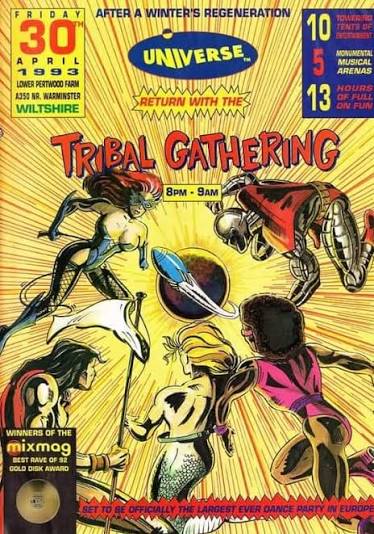
30 April 1993, Lower Pertwood Farm near Warminster, Wiltshire. 25,000 people came for Laurent Garnier, Carl Cox, Aphex Twin, DiY Sound System and Pete Tong. The same year, the "Universe – World Techno Tribe" compilation charted at No.4 in the UK album charts.
Final Frontier, and a move to Munich
The Criminal Justice Bill made huge outdoor raves harder to stage, so Tribal Gathering relocated to Munich's old airport with The Prodigy and Underworld. At home, Shurey and Ian Jenkinson opened the weekly club night Final Frontier at Club UK — later ranked the 5th greatest club night ever by Musik Magazine, just behind Studio 54 and Paradise Garage.
The first legal all-nighter
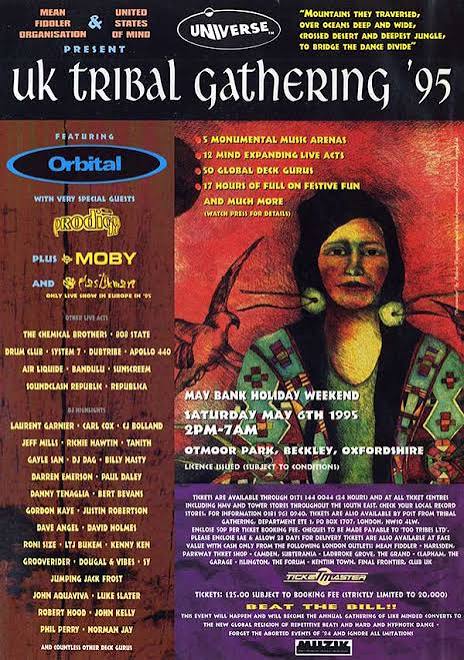
Partnering with the Mean Fiddler organisation, Tribal Gathering staged the UK's first legal all-night festival at Otmoor Park, Beckley, Oxfordshire — headlined by The Prodigy, Orbital and Moby.
Luton Hoo, and a line-up for the ages
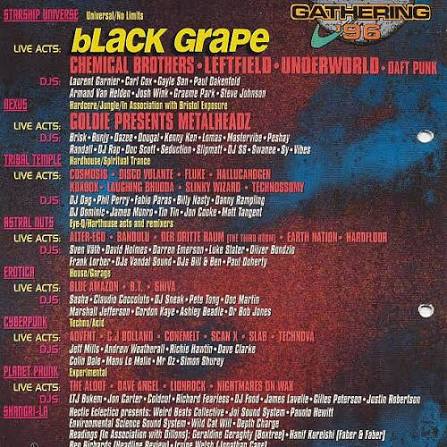
30,000 people at Luton Hoo, Bedfordshire, for Underworld, Leftfield, The Chemical Brothers, Black Grape, Goldie and Daft Punk. It's still remembered by the music press as one of the greatest electronic festival bills ever assembled.
Kraftwerk return to the UK
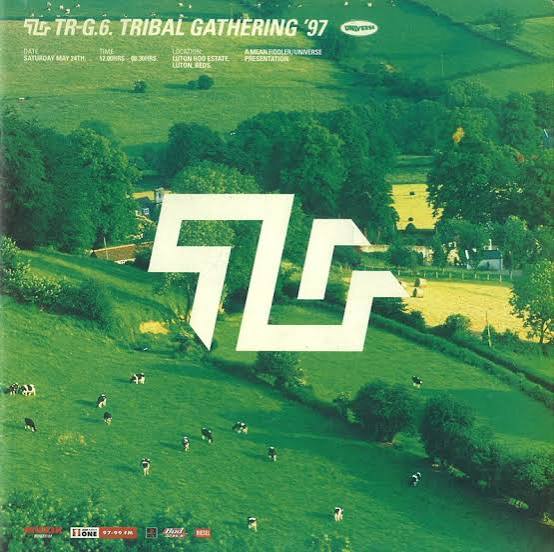
Back at Luton Hoo, Kraftwerk headlined their first UK show since 1992 — a coup that made the festival's name, even without new material to promote.
A brand outgrows itself
By 1998 Tribal Gathering had become a genuine brand — albums, a TV show, plans to go global. A legal dispute over the name between Universe and Mean Fiddler stalled the event that year. In 1999, David Vincent bought the Tribal Gathering name with the intention of reviving it.
Tribal Sessions, Sankeys Soap
The name returned as a weekly club night at Sankeys Soap, Manchester. Tribal Sessions ran residencies from Richie Hawtin, Jeff Mills, Carl Cox, Sasha and Laurent Garnier, later winning Mixmag's Best Club of the Year in 2004 and earning two exhibitions at the Manchester Museum of Science and Industry.
Southport, and the Haçienda warehouse
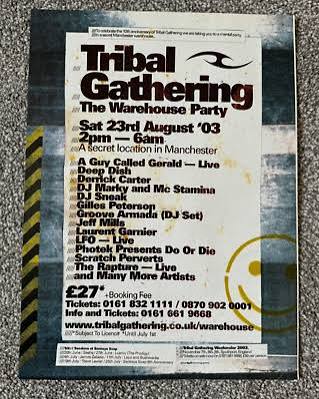
A sold-out 5,000-capacity weekender at Southport Pontins in 2002 was followed in 2003 by the first legal UK warehouse party in over a decade — staged in a Manchester building dressed as the Haçienda for the film 24 Hour Party People. 12,000 people came for Groove Armada, Laurent Garnier, Jeff Mills and Deep Dish; Mixmag named it Event of the Year and, in 2004, the second-best party of all time. A second Manchester warehouse party followed in 2004.
A benefit, and a pause
A 2005 festival planned for Luton Hoo in aid of war victims in Darfur, Sudan, was cancelled following the 7 July London bombings. Tribal Gathering went quiet.
Footage from the field
Raw sets and aftermovies from the original events, kept alive by the people who were there.
Off the wall
The paper trail — five flyers spanning the festival's first decade, from a Wiltshire farm to a Manchester warehouse.
Back on the ground
Tribal Gathering is rebuilding the way it started: grassroots first, big field second.
Tribal Sessions returns to Sankeys
Back where the name was revived in 2000 — Sankeys, Manchester. Grassroots club nights, rebuilding the community before we go bigger.
Tribal Gathering, full return
A full-scale Tribal Gathering event, built on everything the club nights re-establish in 2026. Details to follow.
Tribal Gathering was built on bringing people together through electronic music. As we enter our next chapter, we remain committed to musical freedom, community, diversity and discovery — championing established pioneers alongside the next generation, and celebrating the Black, LGBTQIA+ and underground cultures that shaped this music. Great events should be welcoming and accessible to all. Our future will be built responsibly: inclusion, sustainability and fair opportunity, with the culture always at the centre.